
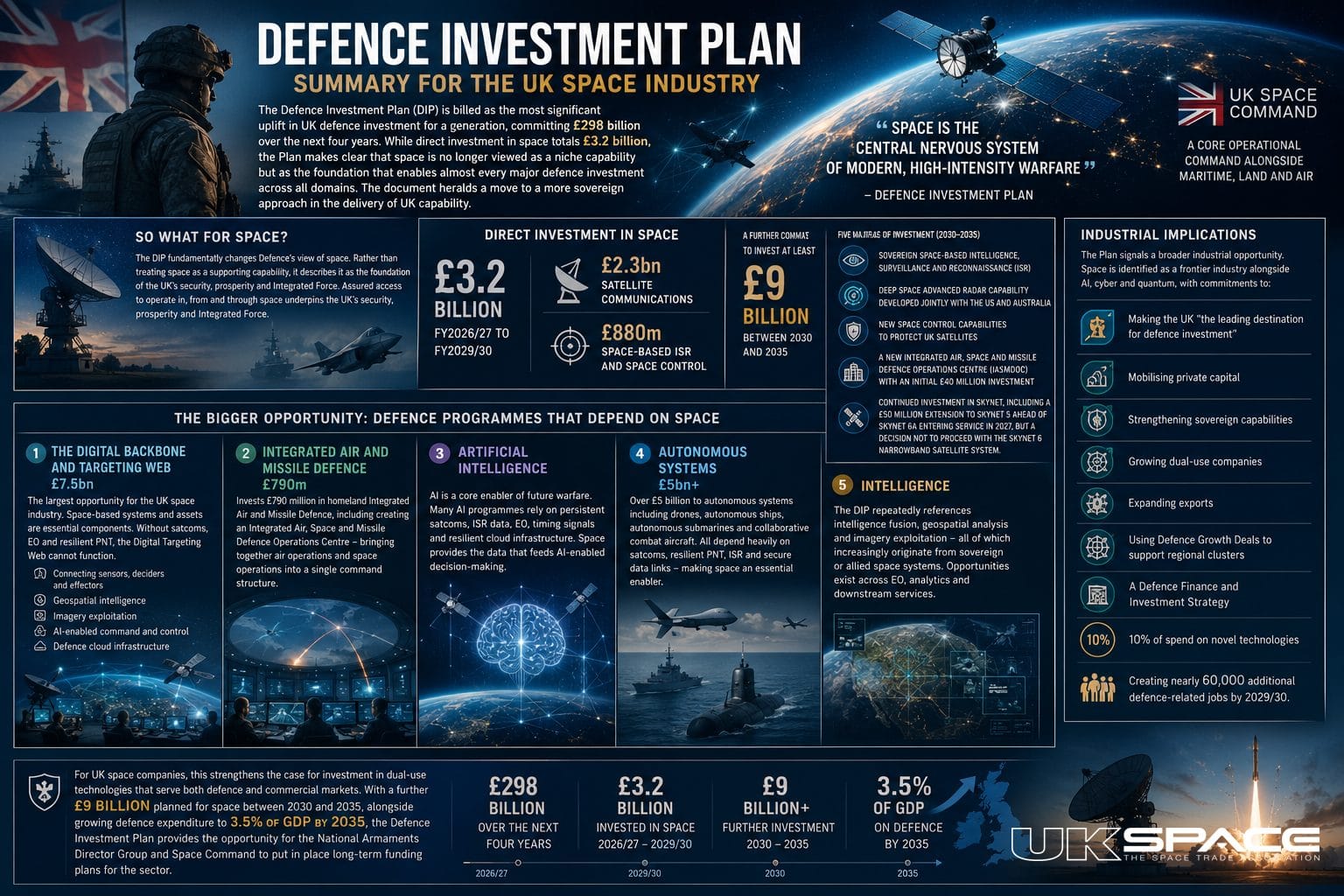
The Defence Investment Plan (DIP) is billed as the most significant uplift in UK defence investment for a generation, committing £298 billion over the next four years. While direct investment in space totals £3.2 billion, the Plan makes clear that space is no longer viewed as a niche capability, but as the foundation that enables almost every major defence investment across all domains. The document heralds a move to a more sovereign approach in the delivery of UK capability.
So What for Space?
The DIP fundamentally changes Defence’s view of space. Rather than treating space as a supporting capability, it describes it as: “the central nervous system of modern, high-intensity warfare” and states that assured access to operate in, from and through space underpins the UK’s security, prosperity and Integrated Force. Space Command is therefore positioned as a core operational command alongside the traditional maritime, land and air domains.
Direct investment
The DIP allocates £3.2 billion between FY2026/27 and FY2029/30 specifically to the Space domain. Funding is split between £2.3bn for Satellite Communications and £880m for Space-based ISR and Space Control. What these relate to is not specific.
This is followed by a commitment to invest at least £9 billion between 2030 and 2035 as the Strategic Defence Review is implemented. The Plan identifies five major areas of investment:
- Sovereign space-based Intelligence, Surveillance and Reconnaissance (ISR)
- Deep Space Advanced Radar Capability developed jointly with the US and Australia
- New Space Control capabilities to protect UK satellites
- A new Integrated Air, Space and Missile Defence Operations Centre (IASMDOC) with an initial £40 million investment
- Continued investment in SKYNET, including a £50 million extension to SKYNET 5 ahead of SKYNET 6A entering service in 2027, but a decision not to proceed with the SKYNET 6 Narrowband Satellite System.
The much bigger opportunity could be the defence programmes that depend on space:
1. The Digital Backbone and Targeting Web (£7.5bn)
This is arguably the largest opportunity for the UK space industry. The proposed investment references space-based systems and assets which are essential components of the targeting web and which UKspace members could pursue through the new defence procurement structures. Without satellite communications, Earth observation (EO) and resilient Position, Navigation and Timing (PNT), the Digital Targeting Web cannot function. Areas impacted would include:
- Connecting sensors, deciders and effectors
- Geospatial intelligence
- Imagery exploitation
- AI-enabled command and control
- Defence cloud infrastructure
2. Integrated Air and Missile Defence (£790m)
The DIP invests £790 million in homeland Integrated Air and Missile Defence. Crucially, this includes creating an Integrated Air, Space and Missile Defence Operations Centre, bringing together air operations and space operations into a single command structure. This represents one of the clearest institutional changes for Defence space since UK Space Command was established.
3. Artificial Intelligence
AI is presented as a core enabler of future warfare. Many AI programmes rely upon persistent satellite communications, ISR data, EO, timing signals and resilient cloud infrastructure. Space could become a key source of data feeding AI-enabled military decision-making.
4. Autonomous systems (£5bn)
The Plan commits over £5 billion to autonomous systems including drones, autonomous ships, autonomous submarines and collaborative combat aircraft. These assets all depend heavily upon satellite communications, resilient PNT, ISR and secure data links, making space infrastructure an essential enabling capability.
5. Intelligence
The DIP repeatedly references intelligence fusion, geospatial analysis and imagery exploitation, all of which increasingly originate from sovereign or allied space systems. This creates opportunities across EO, analytics and downstream services.
Industrial implications
Beyond procurement, the Plan signals a broader industrial opportunity because it repeatedly identifies space as a frontier industry alongside AI, cyber and quantum, and commits to:
- Making the UK “the leading destination for defence investment”
- Mobilising private capital
- Strengthening sovereign capabilities
- Growing dual-use companies
- Expanding exports
- Using Defence Growth Deals to support regional clusters
- A Defence Finance and Investment Strategy
- 10% of spend on novel technologies
- Creating nearly 60,000 additional defence-related jobs by 2029/30.
For UK space companies, this strengthens the case for investment in dual-use technologies that serve both defence and commercial markets. With a further £9 billion planned for space between 2030 and 2035, alongside growing defence expenditure to 3.5% of GDP by 2035, the Defence Investment Plan provides the opportunity for the National Armaments Director Group and UK Space Command to put in place long-term funding plans for the sector.